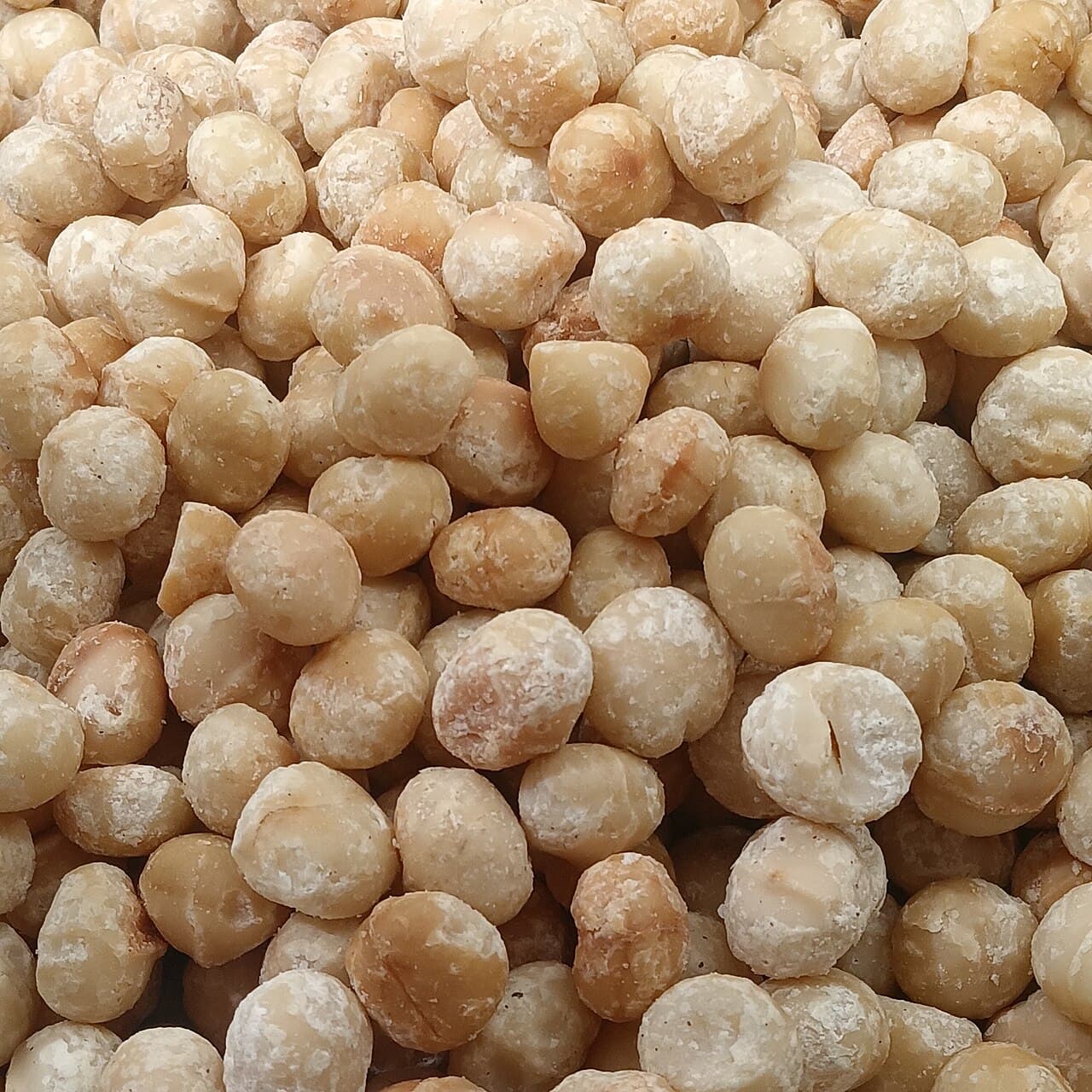
What should you pay for macadamia nuts in South Africa? In mid 2026, the honest answer is that the retail price per kg for macadamia kernels sits between roughly R240 and R360. That is a wide band, and the difference is not marketing. It comes down to grade, style, freshness and how many hands the nuts passed through before they reached you. We sell macadamias for a living, so this is the guide we wish every customer could read before comparing prices on a shelf or a screen.
One thing upfront: a cheap macadamia is not automatically a bargain, and an expensive one is not automatically better. You need to know what you are looking at.
Current macadamia prices in South Africa
These are the numbers that matter in the 2026 season, from published market data rather than thumb-suck:
| What is being priced | Price (2026 season) | Context |
|---|---|---|
| Retail kernels (shops, online) | ± R240 to R360 per kg | Raw or roasted, depending on grade and packaging |
| Whole-kernel price paid to growers | ± US$14.10 per kg | Up 4.4% on last season |
| Halves and pieces paid to growers | ± US$9.04 per kg | Down 8.7% on last season |
Those grower prices come from Farmers Weekly's 2026 price report, and they explain something you will see on shelves: whole kernels are getting more expensive relative to halves and pieces. If your budget is tight, buying halves for baking instead of whole kernels for snacking is the single easiest saving.
There is a currency story underneath too. The rand strengthened from around R18.25 to the US dollar last season to about R16.50 at the start of this one. Good for anyone importing tractors. Less good for growers, since our crop is priced in dollars, and it is one reason farm-gate income is tighter this year even though dollar prices for whole kernels rose.
Why macadamias cost more than other nuts
We get asked this at every market we attend, usually while someone weighs a bag of our roasted kernels in one hand and remembers the price of peanuts. The short version:
- The wait. A macadamia tree takes about seven years to bear a crop worth harvesting. Someone carried the cost of land, water and care for those years before the first kilogram was sold.
- The shell.Macadamias have the hardest shell of any commercial nut. Cracking it without shattering the kernel inside takes proper machinery and careful drying first. Roughly two thirds of an in-shell nut's weight is shell that gets discarded or mulched.
- Export competition. South Africa exports about 95% of its crop, mostly as kernel to the USA and Europe and as in-shell nuts to China. Every kilogram sold locally is a kilogram a processor could have exported at dollar prices, so local prices track the world market.
- Hand work. Sorting is still partly done by eye and hand, even in modern plants. Style 0 kernels are hand-checked. That labour is in the price.
We wrote a full walk-through of that journey in how macadamia nuts are harvested and processed if you want to see where each rand goes.
Kernel styles and grades, decoded
The industry grades kernels into styles, and the style is the biggest driver of price after freshness. The World Macadamia Organisation's style guide sets out the full list, but for a shopper the ones that matter are:
- Style 0: large whole kernels, at least 95% whole, over 20 mm. The premium snacking grade and the most expensive. This is what we pack as our signature raw kernels.
- Style 1: whole kernels a size down, 16 to 21 mm. Still premium, slightly kinder on the wallet.
- Style 4: halves, typically 10 to 15 mm. Perfect for baking and cooking. Noticeably cheaper per kilogram.
- Styles 5 and 6: chips and pieces, 5 to 12 mm. The workhorse grades for granola, biscuits, ice cream and nut butter. The cheapest way to eat macadamias, and nutritionally identical to Style 0.
That last point deserves repeating. A chip is not a lesser nut. It is the same kernel that broke during cracking. If you are blending, baking or making pesto, buying Style 0 is paying for wholeness you are about to destroy with a knife.
Raw or roasted: which should you buy?
Raw kernels keep longer, work in more recipes and let you roast to your own taste. Roasted and salted kernels are ready to eat and, in our experience, what most snackers actually finish. Neither is simply better. Raw is not automatically healthier either; the differences are small, and we go through them honestly in our post on what macadamias do for you. Price-wise, expect roasted to carry a modest premium for the processing.
One practical tip from our own kitchen: if you find a good price on raw kernels, take it and roast at home. Fifteen minutes in a low oven. We covered the method in our roasting and storage guide.
How to judge quality before you pay
Price tells you less than the nut itself. Check these before buying, and afterwards while you still can return them:
- Colour. Good kernels are pale cream to light ivory. Deep yellow or brown patches on raw kernels suggest age or poor drying.
- Smell. Fresh macadamias smell faintly sweet and buttery. A sharp smell like old paint or nail polish remover means the oils have gone rancid. Return them.
- Snap. A fresh kernel breaks with a clean snap. A stale one bends and chews.
- Packaging. Vacuum-sealed or well-sealed opaque packaging protects the oils from light and air. Nuts scooped from an open bin at room temperature have a hard life behind them.
- Season. Our harvest runs March to August. Stock packed shortly after harvest has months more life in it than stock that sat in a warehouse for a year. Sellers who pack their own will happily tell you the season. Silence is an answer too.
Where to buy in South Africa
Supermarkets are convenient but usually the most expensive per kilogram, and turnover on premium nuts can be slow. Online retailers are competitive on bulk. Farm stalls and growers who sell direct often give you the best combination of price and freshness, because there is no middle layer and the seller knows exactly when the nuts were cracked.
Buying for a bakery, a roastery or a gift company rather than a kitchen cupboard? The rules change at volume, and we set them out in our guide to buying macadamias in bulk, including the spec sheet to send with your enquiry.
That last option is, unsurprisingly, what we offer. Our range covers raw Style 0 kernels, roasted and salted, in-shell nuts, halves and pieces for baking, and cold-pressed oil, all from our own orchards in Mpumalanga. If you want current prices, pack sizes or bulk rates, send us an enquiry and a person, not a bot, will come back to you. Tell us how you plan to use them and we will tell you honestly which grade to buy. Half the time the answer costs you less than you expected to spend.