If you want to understand how macadamia nuts are harvested and processed, start with one fact that surprises almost everyone: we do not pick macadamias. A macadamia falls when it is ready, on its own schedule, and everything a farm does from that moment is a race to protect the kernel from its two great enemies, moisture and time. We run that race every season from March to August. This is what it looks like from inside, in the order it happens.
The harvest: gathering, not picking
A mature macadamia drops from the tree in its green husk, and the orchard floor becomes the collection point. Through the season we sweep every block on a rotation, every week or two, because a nut lying on damp ground is quietly deteriorating, and the local rats and vervet monkeys treat slow farmers as a catering service.
On smaller farms and steep ground the gathering is done by hand, crews moving down the rows with buckets. Bigger operations run mechanical harvesters that sweep and vacuum the nuts off mown orchard floors. Either way the principle is the same: get the nuts off the ground and into the shed quickly, then go back next week and do it again, because the trees drop at their own pace across five or six months. Nobody who has done a season of it calls farming macadamias passive income after that.
Dehusking: the 24-hour deadline
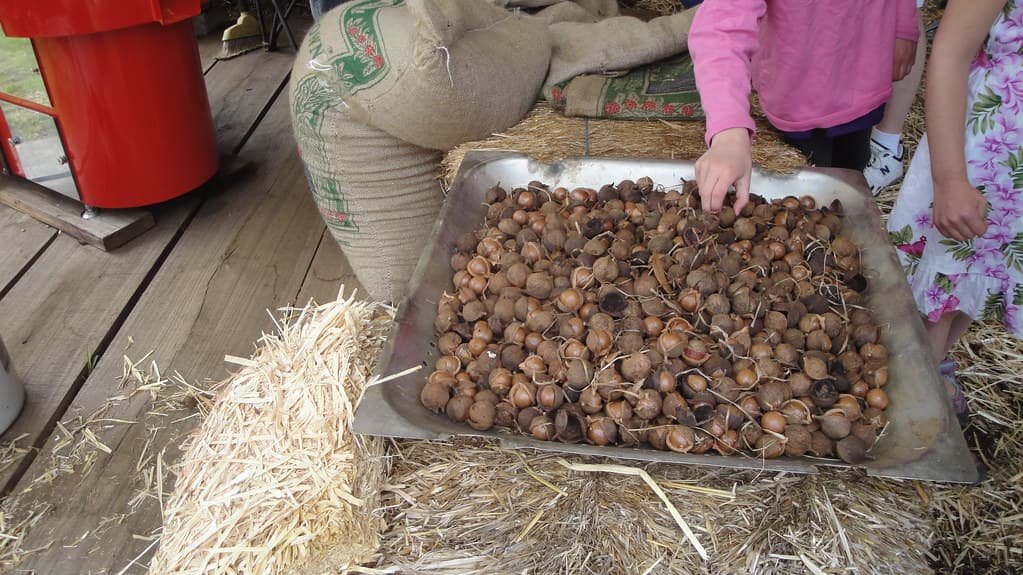
The husk, that green leathery jacket, comes off the same day the nuts leave the orchard, and at worst within 24 hours. It is not fussiness. A husked-on nut sweats. The husk holds moisture and heat around the shell, fermentation starts, mould follows, and the off-flavours reach the kernel long before you can see anything wrong. So every load goes through the dehusker, usually a rotating drum that rubs the husk off, within hours of arriving.
The husks do not go to waste. They go straight back into the orchard as mulch and compost. On our farm the trees literally eat their own jackets, which pleases us more than it probably should.
Drying: the slowest, most important step
A freshly fallen nut carries a lot of water; kernel moisture can be as high as 30% at harvest. Before anyone can crack it, that must come all the way down to around 1.5%. Not 5%, not 3%. Around 1.5%, the industry benchmark for export-grade kernel.
The drying happens in stages, first with ambient air on the farm, then with gently warmed air in drying silos, over weeks rather than days. Rushing it with high heat damages the oils and the flavour, so patience is a quality control measure. Two things happen as the moisture drops. The flavour concentrates into that signature buttery sweetness. And, crucially, the kernel shrinks away from the inside of the shell. That shrinkage is the trick that makes the next step possible.
This is also the step load shedding made famous in our industry. A drying silo cannot pause for four hours without consequences, so generator capacity became as much a part of macadamia farming as irrigation. You learn the price of diesel per kilowatt very precisely.
Cracking: the hardest shell in the business
The macadamia shell is the hardest of any commercial nut, which is why you have never idly cracked one at a bar the way you would a peanut. Processors use mechanical crackers, typically counter-rotating drums or hardened blades set to a precise gap, tuned to split the shell cleanly while the shrunken kernel inside escapes whole.
It never escapes whole every time. The percentage of usable kernel recovered, the crack-out or sound kernel recovery, is the number every farmer and processor watches like a heart monitor, because it is where the season's profit hides. As a rough rule, only about a third of the in-shell weight ends up as kernel. The shells, like the husks, get a second life as biomass fuel and mulch.
The same physics applies at your kitchen table, minus the drums. If you buy in-shell nuts, our guide to cracking macadamias without destroying the kernel covers the seam, the tools that work and the drying step people skip.
Kernels that crack clean and whole become the premium grades. Kernels that break become halves and pieces. Same nut, same orchard, same flavour, very different price, which is worth knowing before you shop. We wrote a full explainer on that in our macadamia price guide.
Sorting and grading: where the styles are born
After cracking, the kernels move through sorting lines. Optical sorters check colour and flag anything dark, immature or damaged. Air separation pulls out shell fragments. And then, still, human eyes and hands do the final pass on the premium lines, because a machine has yet to match a practiced sorter picking out the kernel that is merely almost right.
This is where the industry's style grades come from: Style 0 for large whole kernels, Style 1 a size down, Style 4 for halves, Styles 5 and 6 for chips and pieces. The style on the label tells you the size and wholeness of what is inside, not the quality of the nut itself. A Style 6 chip from a good farm beats a stale Style 0 from anywhere.
Packing: sealing the clock
A finished kernel at 1.5% moisture is stable but not invincible. Oxygen is the last enemy, so kernels are packed fast, usually vacuum-sealed or nitrogen-flushed, into barrier packaging that keeps air and light out. From there they ship to roasters, retailers, bakeries and homes, and about 95% of the South African crop ships overseas. The short version of that story is in our post on macadamia farming in South Africa.
From the moment the packet is opened, the clock restarts in your kitchen, and how you store them decides the rest.
How long the whole journey takes
From the thud on the orchard floor to a sealed pack is a matter of weeks, most of it drying. Gathering and dehusking happen inside a day or two. On-farm drying takes days to a couple of weeks depending on the weather and the setup. Final drying at the processor, down to that 1.5%, adds more weeks, because gentle is slow by definition. Cracking, sorting and packing then move fast, usually days.
Every batch carries its paper trail through all of it: which orchard block, which harvest sweep, which drying run. That traceability is an export requirement, but it is also how a farm learns. When a batch cracks out badly, the records tell you whether to blame the cultivar, the weather or yourself.
Why we bother telling you all this
Because every shortcut in this chain is tasteable. Nuts swept late, dehusked slowly, dried hard and fast, or stored warm all end up on a shelf somewhere looking identical to nuts that were handled right. The difference only shows up when you eat them. We put a visual version of our own chain on the process page, and everything we sell on the products page went through exactly the steps above, on one farm, under our own eyes.
Questions about any step, or want to see it in person during harvest? Get in touch. Between March and August, come see the dehusker run. We are told it is unexpectedly satisfying to watch.