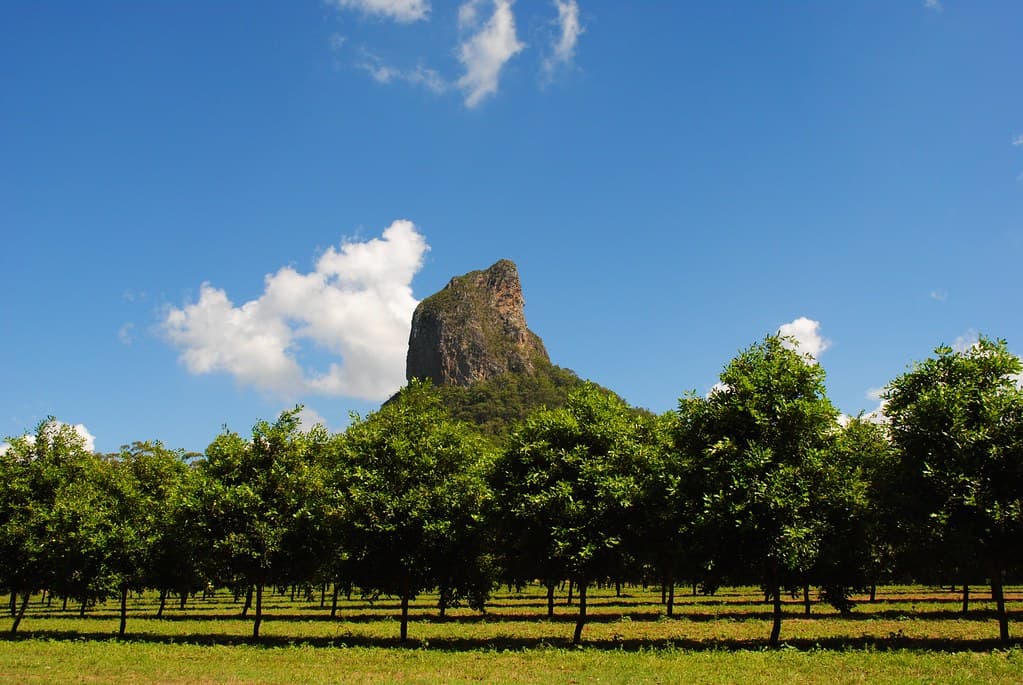
Macadamia farming in South Africa is a young industry wearing an old country's work ethic. The tree itself is Australian. The business of growing it at scale, cracking it, grading it and shipping it to the world is now more South African than anything else: South Africa is the world's biggest producer and exporter, with more than 700 growers and an estimated crop of over 90,000 tonnes of nut-in-shell in 2025, according to the USDA's 2025 industry report. That is over 30% of the world's kernel supply, from a crop that barely existed here two generations ago.
We farm in Mpumalanga, so this is not a neutral account. It is the view from inside the orchard, with the numbers checked.
The three regions that grow almost everything
If you plotted every macadamia tree in the country, three clusters would light up.
Limpopo: where it started
The industry's birthplace is the far north, in Levubu near Louis Trichardt and around Tzaneen. Sub-tropical valleys, deep soils and early pioneers who planted macadamias when everyone else thought avocados were the future. Limpopo holds roughly 20% of the country's planted hectares today, and Levubu alone carries around 10,000 hectares of trees. Some of those orchards are old enough that the farmers who planted them have retired watching them bear.
Mpumalanga: the biggest plantings
Our home ground. The Lowveld, from Nelspruit (Mbombela) through Hazyview to Barberton, holds about 40% of planted hectares, the most of any province. Warm, frost-free winters, summer rain and established fruit-farming infrastructure made the switch to macadamias natural here. Drive the R40 in May and you will pass orchard after orchard with harvest crews sweeping beneath the trees.
KwaZulu-Natal: the fast mover
KZN holds around 34% of hectares and is the fastest-growing region, especially the South Coast strip from Port Edward through Paddock. The humid coastal climate suits the trees, and sugarcane land has been converting to macadamias at pace. Recent seasons have seen KZN produce the largest share of the national crop.
There are smaller plantings pushing into the Eastern and Western Cape too. The tree is choosier than sugarcane but less fussy than people assume, provided it gets water and protection from frost.
A year in a macadamia orchard
The macadamia calendar shapes everything about how we work, and it runs against the northern hemisphere's clock.
- August to September: flowering. The trees hang full of long cream-coloured racemes, each one carrying dozens of tiny flowers. Bees earn their keep. A hailstorm now, and you feel it in your stomach for the rest of the year.
- October to February: nut set and oil accumulation through the summer rains. The kernels fill and the husks harden. Irrigation, pest scouting and holding your nerve.
- March to August: harvest. Mature nuts drop to the orchard floor on their own schedule, and we gather them in repeated sweeps, every week or two, block by block. A nut lying too long on wet ground is a nut lost to mould or rats, so the sweeps do not wait for convenient weather.
From the orchard floor the clock speeds up: dehusking within a day, then slow drying, cracking and grading. That deserves its own story, and we tell it properly in from orchard to packet, with a shorter version on our process page.
The trees themselves
Commercial macadamias are cultivars of Macadamia integrifolia, the smooth-shelled species, or hybrids with the rougher-shelled Macadamia tetraphylla. In South Africa the workhorse is Beaumont, a hybrid that crops heavily and suits our conditions, planted alongside integrifolia selections chosen for kernel quality and crack-out. Most farms run several cultivars deliberately: they flower and drop at slightly different times, which spreads the harvest, spreads the risk, and keeps the pollinators busier for longer.
An orchard is laid out for decades, not seasons. Row spacing decided in year one determines whether machinery fits between the trees in year fifteen. It is chess played against your own future self, and every grower has one spacing decision they would take back.
How South Africa took the lead
In 2006 the national crop was around 16,000 tonnes. By 2025 it passed 90,000. That is not a gentle climb, it is a sixfold surge in under twenty years, and it happened for unglamorous reasons: farmers who already knew sub-tropical agriculture, processors who invested in world-class cracking plants, an industry body ( SAMAC) that funds research and market development from grower levies, and a rand that makes export earnings attractive.
Australia, the crop's home, held the crown for decades. China is planting aggressively and will matter more every year. For now, South Africa leads, and the industry here is projected to keep growing, with some forecasts seeing the crop doubling over the next decade.
Where does it all go? About 95% leaves the country. Kernel goes mostly to the United States and Europe. In-shell nuts go overwhelmingly to China, where cracking them at home is part of the appeal. The five-ish percent that stays behind is what you find in local shops, which is also why local prices track the world market. We unpack that in our guide to macadamia prices in South Africa.
What it actually takes to farm macadamias
Every second dinner party, someone tells us they are thinking of planting macadamias. Here is the honest version we give them.
The tree makes you wait. Roughly seven years from planting to a crop worth the diesel it takes to harvest it. Through those years you are paying for irrigation, fertiliser, pruning and pest control against income of zero. Hail can undo a season in ten minutes. Stinkbugs quietly ruin kernels from the inside, and you only find out at cracking. Water is the permanent worry; these are thirsty trees in a dry country, which is why sensor-driven irrigation has gone from luxury to standard kit. And when the power fails during drying season, generators run, because a drying shed cannot simply pause. Load shedding taught this industry more about backup power than any consultant ever did.
It is also, on the good days, the best work we know. A winter morning in the rows, trees heavy, the knock of nuts into the trailer. There is a reason sugarcane farmers keep converting.
Why any of this matters to you as a buyer
Because origin is not a sticker, it is a supply chain. Macadamias grown, cracked and packed here reach you months fresher than stock that crossed an ocean twice. When you buy from a South African grower you are buying from the source country of the world's largest crop, at the shortest possible distance from the tree.
Ours grow in the Mpumalanga Lowveld, and everything we sell comes from orchards we can walk you through. Have a look at what we pack, read our story, or get in touch if you would like to stock, buy in bulk, or just ask a farming question. We answer those for free.